શનિવાર, 14 માર્ચ, 2020

સોમવાર, 16 ડિસેમ્બર, 2019

બુધવાર, 20 નવેમ્બર, 2019

શનિવાર, 16 નવેમ્બર, 2019

બુધવાર, 27 જૂન, 2012

બુધવાર, 6 જુલાઈ, 2011

My friends


                      Vinod

રવિવાર, 5 જૂન, 2011

Learn a stitch-Knotted chain stitch,a Tutorial

Learn a stitch-Knotted chain stitch,a Tutorial

I came across the knotted chain stitch while looking around for a new stitch for outlining. It looked like a good stitch for decorative lines and borders. But different sites had different interpretations for the same stitch . The Wikipedia showed the stitch this way :-

On the other hand, artsanddesigns had a slightly different version. This stitch is also known by the name of link stitch and I think the above picture justifies the name.

The arrow points towards the original stitch as shown in Wiki. Click on the photograph for a better view. If the knots are placed slightly far apart or pulled a little tight , we get the other variations.Have a look at the close up below.

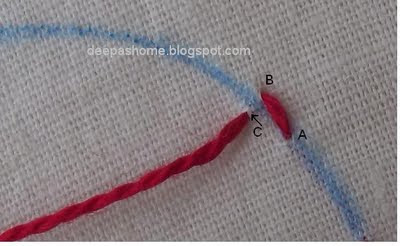

Let us see how a knotted chain stitch is made :

Step 1 : Come up at a point A on the reference line. This stitch is worked from right to left.


Step 2: Insert the needle at a point B above the line and come out at the point C. Make sure that the gap between B and C is not too large. If it is too long, the knot will have two legs jutting out .


Step 3: Pull through to make the base stitch.


Step 4: Now starts the knotting part. Pass the needle through the base stitch from B to C ,without piercing the fabric.

A good deed takes you a long way...

A good deed takes you a long way...

This was one of the forwarded mails I received today from a friend. Imagine my surprise on receiving this in my inbox, just when I had my own doubts about doing good to others .

I wish there many more young woman like the one in this story who would do good to others and a few like Dr.Howard Kelly (you cannot expect all to be like him,right?) who would at least acknowledge the good deeds.

I do not ask for money or a favor back ,but a smile on your face when you see me or a just a call to say hello would be more than enough.

Wondering what the story is about?....Read on...


GLASS OF MILK

One day, a poor boy who was selling goods from door to door to pay his way through school, found he had only one thin dime left, and he was hungry.

He decided he would ask for a meal at the next house. However, he lost his nerve when a lovely young woman opened the door.

Instead of a meal he asked for a drink of water! . She thought he looked hungry so brought him a large glass of milk. He drank it so slowly, and then asked, How much do I owe you?"

You don't owe me anything," she replied. "Mother has taught us never to accept pay for a kindness."

He said ... "Then I thank you from my heart."

As Howard Kelly left that house, he not only felt stronger physically, but his faith in God and man was strong also. He had been ready to give up and quit

Many year's later that same young woman became critically ill. The local doctors were baffled. They finally sent her to the big city, where they called in specialists to study her rare disease.

Dr. Howard Kelly was called in for the consultation. When he heard the name of the town she came from, a strange light filled his eyes.

Immediately he rose and went down the hall of the hospital to her room.

Dressed in his doctor's gown he went in to see her. He recognized her at once.

He went back to the consultation room determined to do his best to save her life. From that day he gave special attention to her case.

After a long struggle, the battle was won.

Dr. Kelly requested the business office to pass the final bill to him for approval. He looked at it, then wrote something on the edge and the bill was sent to her room. She feared to open it, for she was sure it would take the rest of her life to pay for it all. Finally she looked, and something caught her attention on the side of the bill. She read these words ...

"Paid in full with one glass of milk"

(Signed) Dr. Howard Kelly.

Tears of joy flooded her eyes as her happy heart prayed: "Thank You,
God, that Your love has spread broad through human hearts and hands."

There's a saying which goes something like this: Bread cast on the waters comes back to you. The good deed you do today may benefit you or someone you love at the least expected time. If you never see the deed again at least you will have made the world a better place - And, after all, isn't that what life is all about?

Love,luck and sunshine,
Deepa

update : Vicki W(Ryan) posted a link in the comments about this story which has been doing the rounds of the internet for quite some time. While the story is true, some embellishments have been added to make it touching.Still, whatever be the exaggerations, I like the fact that Dr. Kelly recognized and acknowledged the girl's good deed.

Fixing Shisha(mirror) with Kutch embroidery


Have you tried fixing shisha with kutch work?

That's what Iam doing now. After the doodling on my daughter's pyjama , Iam trying shisha on the remaining one.
The inspiration came from a couple of pictures of a pouch which Anne mailed me asking about the stitch used. Anne bought this piece while on a trip to Jaipur,Rajasthan.


Kutch work is also known by the name Sindhi stitch, Sindhi taropa, Kutchi kadai or Maltese cross and is related to Armenian embroidery .The embroidery is believed to have travelled across continents thanks to nomadic tribes.There are quite a few tutorials available online which teaches the basics of this interlacing work.

But the tutorial for this pattern was not available .So I had to experiment a bit on it.

First I tried the stitch without mirror/sequin.


The squares were too big. This wouldn't do for little one's pyjama.

Second attempt. Still not small enough.
Third attempt on the pyjama with small square and a big sequin.First I tacked down the sequin with red thread(sheesh!!) Never thought that the thread will be visible through the gap.In the second attempt (the incomplete one) I didn't even bother to tack down the sequin.


Her royal highness was happy to see this one...but then, she again asked the question ....ma,where are the beads?

So, I am off to add beads now and complete the rest of interlacing.

If in case you need a tutorial on how to do this particular pattern,do let me know.

A child's pleasure v/s aesthetic sensibilities


If there is a conflict between the two, who wins in the end?

The little one,of course :)

After the kutchwork shisha on the pyjamas, I tried my level best to put an end to the little lady's demand for more bling on it. But she was persistent . So I buried all my artistic senses and added these ....

Flowers with Kundan and a round of seed beads in the middle and two layers of flat sequins as petals.


These are the kind of flowers found commonly in Indian dresses .Since stitching these flowers take some time, more the number of flowers , the more expensive the dress will be.

Needless to say, she was in seventh heaven and wore it immediately without even allowing me to add some connecting vines .

Thus the pyjama saga ends!!

Love,luck and sunshine,
Deepa

Handmade Lace - Anyone knows the name?

Some days back, I had visited a friend of mine recuperating after a surgery at her mom's place. While conversing on different forms on handwork ,which is our common interest, her mom showed me some laces she had made. She had learnt it from a relative of hers many years ago. She wanted to know if I knew the name of the method and if other patterns were available.


I've no knowledge of laces or lace making,so I clicked a few pics of some of the lace strips made by her so as to show you all. If anyone of you know anything about this method and resources ,please do let me know so that I can pass it on to her.


She makes these laces with two long spokes she has resourced from a cycle wheel.From what she has told me there are some formulas involved and the creation requires lot of time. But isn't all lace making laborious and time consuming?


I've left the pictures big enough so that you can have a closer look. What do you think? Is this knitting lace? Iam making a guess since it uses two needles.

If anyone is aware of this method ,please leave a comment here in this post.

Love,luck and sunshine,
Deepa

સોમવાર, 9 મે, 2011

Food and drink

The majority of the population is vegetarian. Jains, Buldhmins and some other caste perform strict vegetarianism. Jains also refrain from eating kandmool food grown below the ground such as potatoes, garlic, onion, suran, etc. Hindus perform various degree of vegetarianism but certainly do not eat beef.
In the villages, staple foods include bajra and milk; bajara na rotla with curd and butter milk is very common food for all the Gujarati people. Bajra was introduced by a brave king of this region named Lakho Fulani. During his period of exile, he came to know about this grain in some tribal regions. They also extensively drink buttermilk during lunch. Milk is considered to be sacred food and offering it to somebody is considered a gesture of friendship and welcoming. Settlement of dispute invariably follows offering milk to each other as a concluding remark. In the Kutchi engagement ceremony, the bride's family offers milk to the groom's relatives as a symbol of accepting their relationship.
Tea is the most popular drink in this region and is enjoyed irrespective of sex, caste, religion or social status. Tea stalls where groups of people chat over tea are invariable sights of every village or town entrance from early morning to late evening. Most people drink it with milk and sugar. Offering black tea to guests is considered to be a bad gesture. Tea without milk is offered when people are visiting host to mourn death of relatives. Tea was introduced in this region by the British as part of medicinal purpose to counteract the plague epidemic in the early 19th century. Alcoholic liquor is another popular drink, though it has been illegal to drink or possess since Kutch was incorporated within Gujarat. Most of the liquor drunk in this region is distilled from molasses by local people in villages. As a rule, women do not drink alcohol.

Religion

As per the 2001 census, the district's population was 1,526,331, of which most around are Hindu. The remainder of the population adhere to mostly Jainism and Islam. There are also some Sikhs and a Gurudwara is also situated in kachchh at Lakhpat. This Gurudwara was originally a house where the first Guru Guru Nanak stayed during his journey to Mecca. The Swaminarayan Sampraday has a huge following in this region. Their main temple in this district is Shri Swaminarayan Mandir, Bhuj. Anjar city is the really famous also as Swaminarayan Mandir and Swaminarayanians. A related Sarswat Brahmin are called Kutchhi Sarswat Brahmin. Maheshwari (Maheshpanthi) Shampraday.

Handicrafts

Kachchh has a strong tradition of crafts.
The most famous craft of the region is its diverse embroideries. The finest aari embroidery was carried out for the royalty and wealthy families. Traditionally women in rural areas do the embroidery for their dowries.[6] Unfortunately many of these fine skills have now been lost, though some are being rejuvenated through handicrafts initiatives. In 1950, local social leader Dr. Manubhai Pandhi worked with local artists and the central government to help the dying handicraft. Today over 16 types of embroidery are being produced commercially by a few societies and a couple of private corporations. Some of the finest new embroidery in the world is being produced by over 6,000 women artisans of the region.
Some of the embroideries still being produced in the region are
  1. Kapdi (bava)
  2. Jadeja
  3. Gadhvi (Charan)
  4. Ahir
  5. Pakko
  6. Neran
  7. Kambira
  8. Khudi Teba
  9. Chicken
  10. Katri
  11. Chopat
  12. Gotan
  13. Mukko
  14. Soof
  15. Kharek
  16. Jat - Gracia
  17. Jat - Fakirani
  18. Noday
  19. Jat Daneta
  20. Makwana
  21. Koli

Economy and Industries

Kutch is a growing economic and industrial hub in one of India's fastest growing states - Gujarat. Its location on the far western edge of India has resulted in the commissioning of two major ports Kandla and Mundra. These ports are near most to the Gulf and Europe by the sea route. The hinterland of north-western India hosts more than 50% of India's population. Quality of roads is good in Kutch. The large part of the growth of Kachchh came after tax relief provided by the government as part of 2001 earthquake relief.
Due to the existence of 2 major ports, transportation as a business has thrived. Since historical times the people of Kutch have formed the backbone of trade between Gujarat mainland and Sindh. After the formation of Pakistan this trade stopped for good, but due to the inception of the Kandla port, trade boomed again.
Kutch is Mineral rich region with very large reserve of Lignite,[3] Bauxite, Gypsum among other minerals. Kachchh got tax break for Industries for 15 years after the major earthquake on January 26, 2001. Lignite is mined only by Gujarat Mineral Development Corporation (GMDC) at its 2 mines in Panandhro and Mata no Madh. The Panandaro mines has now been reserved for GEB and GMDC power plants and GMDC has stopped supply to other industries from there.[4] This has adversely affected local trucking business.
Kutch also houses Sanghi Industries Ltd's Cement Plant. It is the India's single largest Cement Plant[citation needed]. The company is now planning to increase the capacity at its Abdasa location from 3–9 million tons per annum.[5] By 2015, the company plans to produce 20 million tons.[5] Kandla port is also in Kutch. It is considered Gateway to India's North. It is managed by the Kandla Port trust.
Other major Industries in Kutch are TATA POWER's first 4000 MW Ultra Mega Power Project(UMPP)of India. Adani Power expects to tie up funds for it's 3300 MW plant by March 2012 and is on track to complete the installation of 10,000 MW projects by 2013. The other major companies are the Welspun Group of Companies, Ajanta Clocks,Orpat , JayPee Cements, Jindal Steel and One of the largest windmill farms concentration. Kutch region is also a major producer of salt.
Kucth district has a scanty forest cover. Hence there is negligible risk of illegal cutting of forests. This coupled with the adequate facilities available at Kandla port has helped establish the timber market. In 1987, "Kandla Timber Association" was formed in order to resolve the specific, problems of Timber Importers and Timber allied industries coming up during the period. The Timber industry is growing at a faster pace with 300 saw mills working in Gandhidham-Kandla Complex.
The Little Rann of Kutch is known for its traditional salt production and various references mention this to be a 600 years old activity. During the British period, this activity increased manifold. It was used to fund a substantial part of the military expenses of the British government. Communities involved in salt production are mainly Chunvaliya Koli, Ahir and Miyana (Muslim), residing in 107 villages in the periphery of Lesser Rann of Kutch. These communities are traditionally known to have the skills of salt production and are known as ‘Agariyas’. Water quality in 107 villages of Lesser Rann of Kutch is saline, thus agriculture is not an option .Hence salt production is the only livelihood option for Agariyas. As per the Salt Commission’s report there are 45000 Agariyas working in the salt pans of Kutch. Out of the estimated total annual production of India of about 180 lakh tonnes, Gujarat contributes 75% - mainly from Kutch and other parts of Saurashtra.
Other Traditional industries in the areas include manufacture of Shawls, handicrafts, and silver items.

People

A Meghwal woman in the Hodka village, north of Bhuj.
Kutch district is inhabited by various groups and communities. Many of these have reached this region after centuries of migration from neighbouring regions of Marwar (Western Rajasthan), Sindh, Afghanistan and further. Even today, one can find various nomadic, semi nomadic and artisan groups living in Kutch.Some communities came from Sind,(mostly Kutchi speaking-Lohanas,Bhatiyas,Khatris..)and some from Saurashtra.(Gujarati speaking-Sorathiya,Ahir,Girnara..)Many migrated from north Gujarat ,especially in Vagad region(Gujarati speaking- Prajapati)
The major groups such as the Lohana, Bhatia, Kapdi, Khumbar, Jadeja, Gadhvi, Darbar, Kathis, Rajputs, Mali Samaj, Leva Patel, Kadva Patel, Brahmins, Nagar Brahmins, Nandwana Brahmins, Khatris, Rabaris, Rajgor, Shah, Bhanushali, Jains (Visa and Dasa Oswal), Kutch Gurjar Kshatriyas, Mistris, Kharwa, Meghwals, Wankars, Vankaras, Ahirs, and many others have adopted a settled lifestyle and have struck a life rhythm close to that of modern-day towns. The Banni region is home to a number of nomadic Sindhi-speaking Muslim groups such as the Dhanetah Jaths, Halaypotra, Sanghar [Kutch Muslam Sanghaar Jamat-now in Karachi] Pakistan Hingora, Hingorja, Rahima, Bhadala, Mutwa, Raysipotra, Sammas, Theba and Node, maintain more traditional lifestyles.


Twitter Delicious Facebook Digg Stumbleupon Favorites More

 
Design by Free WordPress Themes | Bloggerized by Lasantha - Premium Blogger Themes | Walgreens Printable Coupons