This is featured post 1 title
Replace these every slider sentences with your featured post descriptions.Go to Blogger edit html and find these sentences.Now replace these with your own descriptions.
This is featured post 2 title
Replace these every slider sentences with your featured post descriptions.Go to Blogger edit html and find these sentences.Now replace these with your own descriptions.
This is featured post 3 title
Replace these every slider sentences with your featured post descriptions.Go to Blogger edit html and find these sentences.Now replace these with your own descriptions.
બુધવાર, 6 જુલાઈ, 2011
રવિવાર, 5 જૂન, 2011
Learn a stitch-Knotted chain stitch,a Tutorial
I came across the knotted chain stitch while looking around for a new stitch for outlining. It looked like a good stitch for decorative lines and borders. But different sites had different interpretations for the same stitch . The Wikipedia showed the stitch this way :-
On the other hand, artsanddesigns had a slightly different version. This stitch is also known by the name of link stitch and I think the above picture justifies the name.Let us see how a knotted chain stitch is made :
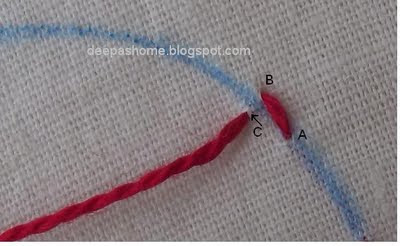
Step 1 : Come up at a point A on the reference line. This stitch is worked from right to left.
Step 2: Insert the needle at a point B above the line and come out at the point C. Make sure that the gap between B and C is not too large. If it is too long, the knot will have two legs jutting out .
Step 3: Pull through to make the base stitch.
Step 4: Now starts the knotting part. Pass the needle through the base stitch from B to C ,without piercing the fabric.
A good deed takes you a long way...
This was one of the forwarded mails I received today from a friend. Imagine my surprise on receiving this in my inbox, just when I had my own doubts about doing good to others .
I wish there many more young woman like the one in this story who would do good to others and a few like Dr.Howard Kelly (you cannot expect all to be like him,right?) who would at least acknowledge the good deeds.
I do not ask for money or a favor back ,but a smile on your face when you see me or a just a call to say hello would be more than enough.
Wondering what the story is about?....Read on...
I wish there many more young woman like the one in this story who would do good to others and a few like Dr.Howard Kelly (you cannot expect all to be like him,right?) who would at least acknowledge the good deeds.
I do not ask for money or a favor back ,but a smile on your face when you see me or a just a call to say hello would be more than enough.
Wondering what the story is about?....Read on...
GLASS OF MILK
One day, a poor boy who was selling goods from door to door to pay his way through school, found he had only one thin dime left, and he was hungry.
He decided he would ask for a meal at the next house. However, he lost his nerve when a lovely young woman opened the door.
Instead of a meal he asked for a drink of water! . She thought he looked hungry so brought him a large glass of milk. He drank it so slowly, and then asked, How much do I owe you?"
You don't owe me anything," she replied. "Mother has taught us never to accept pay for a kindness."
He said ... "Then I thank you from my heart."
As Howard Kelly left that house, he not only felt stronger physically, but his faith in God and man was strong also. He had been ready to give up and quit
Many year's later that same young woman became critically ill. The local doctors were baffled. They finally sent her to the big city, where they called in specialists to study her rare disease.
Dr. Howard Kelly was called in for the consultation. When he heard the name of the town she came from, a strange light filled his eyes.
Immediately he rose and went down the hall of the hospital to her room.
Dressed in his doctor's gown he went in to see her. He recognized her at once.
He went back to the consultation room determined to do his best to save her life. From that day he gave special attention to her case.
After a long struggle, the battle was won.
Dr. Kelly requested the business office to pass the final bill to him for approval. He looked at it, then wrote something on the edge and the bill was sent to her room. She feared to open it, for she was sure it would take the rest of her life to pay for it all. Finally she looked, and something caught her attention on the side of the bill. She read these words ...
"Paid in full with one glass of milk"
(Signed) Dr. Howard Kelly.
Tears of joy flooded her eyes as her happy heart prayed: "Thank You,
God, that Your love has spread broad through human hearts and hands."
There's a saying which goes something like this: Bread cast on the waters comes back to you. The good deed you do today may benefit you or someone you love at the least expected time. If you never see the deed again at least you will have made the world a better place - And, after all, isn't that what life is all about?
Love,luck and sunshine,
Deepa
update : Vicki W(Ryan) posted a link in the comments about this story which has been doing the rounds of the internet for quite some time. While the story is true, some embellishments have been added to make it touching.Still, whatever be the exaggerations, I like the fact that Dr. Kelly recognized and acknowledged the girl's good deed.
Fixing Shisha(mirror) with Kutch embroidery
That's what Iam doing now. After the doodling on my daughter's pyjama , Iam trying shisha on the remaining one.
The inspiration came from a couple of pictures of a pouch which Anne mailed me asking about the stitch used. Anne bought this piece while on a trip to Jaipur,Rajasthan.


Kutch work is also known by the name Sindhi stitch, Sindhi taropa, Kutchi kadai or Maltese cross and is related to Armenian embroidery .The embroidery is believed to have travelled across continents thanks to nomadic tribes.There are quite a few tutorials available online which teaches the basics of this interlacing work.
But the tutorial for this pattern was not available .So I had to experiment a bit on it.
First I tried the stitch without mirror/sequin.
So, I am off to add beads now and complete the rest of interlacing.
If in case you need a tutorial on how to do this particular pattern,do let me know.
A child's pleasure v/s aesthetic sensibilities
The little one,of course :)
After the kutchwork shisha on the pyjamas, I tried my level best to put an end to the little lady's demand for more bling on it. But she was persistent . So I buried all my artistic senses and added these ....
Thus the pyjama saga ends!!
Love,luck and sunshine,
Deepa
Handmade Lace - Anyone knows the name?
Some days back, I had visited a friend of mine recuperating after a surgery at her mom's place. While conversing on different forms on handwork ,which is our common interest, her mom showed me some laces she had made. She had learnt it from a relative of hers many years ago. She wanted to know if I knew the name of the method and if other patterns were available.
I've no knowledge of laces or lace making,so I clicked a few pics of some of the lace strips made by her so as to show you all. If anyone of you know anything about this method and resources ,please do let me know so that I can pass it on to her.
If anyone is aware of this method ,please leave a comment here in this post.
Love,luck and sunshine,
Deepa
સોમવાર, 9 મે, 2011
Food and drink
The majority of the population is vegetarian. Jains, Buldhmins and some other caste perform strict vegetarianism. Jains also refrain from eating kandmool food grown below the ground such as potatoes, garlic, onion, suran, etc. Hindus perform various degree of vegetarianism but certainly do not eat beef.
In the villages, staple foods include bajra and milk; bajara na rotla with curd and butter milk is very common food for all the Gujarati people. Bajra was introduced by a brave king of this region named Lakho Fulani. During his period of exile, he came to know about this grain in some tribal regions. They also extensively drink buttermilk during lunch. Milk is considered to be sacred food and offering it to somebody is considered a gesture of friendship and welcoming. Settlement of dispute invariably follows offering milk to each other as a concluding remark. In the Kutchi engagement ceremony, the bride's family offers milk to the groom's relatives as a symbol of accepting their relationship.
Tea is the most popular drink in this region and is enjoyed irrespective of sex, caste, religion or social status. Tea stalls where groups of people chat over tea are invariable sights of every village or town entrance from early morning to late evening. Most people drink it with milk and sugar. Offering black tea to guests is considered to be a bad gesture. Tea without milk is offered when people are visiting host to mourn death of relatives. Tea was introduced in this region by the British as part of medicinal purpose to counteract the plague epidemic in the early 19th century. Alcoholic liquor is another popular drink, though it has been illegal to drink or possess since Kutch was incorporated within Gujarat. Most of the liquor drunk in this region is distilled from molasses by local people in villages. As a rule, women do not drink alcohol.
In the villages, staple foods include bajra and milk; bajara na rotla with curd and butter milk is very common food for all the Gujarati people. Bajra was introduced by a brave king of this region named Lakho Fulani. During his period of exile, he came to know about this grain in some tribal regions. They also extensively drink buttermilk during lunch. Milk is considered to be sacred food and offering it to somebody is considered a gesture of friendship and welcoming. Settlement of dispute invariably follows offering milk to each other as a concluding remark. In the Kutchi engagement ceremony, the bride's family offers milk to the groom's relatives as a symbol of accepting their relationship.
Tea is the most popular drink in this region and is enjoyed irrespective of sex, caste, religion or social status. Tea stalls where groups of people chat over tea are invariable sights of every village or town entrance from early morning to late evening. Most people drink it with milk and sugar. Offering black tea to guests is considered to be a bad gesture. Tea without milk is offered when people are visiting host to mourn death of relatives. Tea was introduced in this region by the British as part of medicinal purpose to counteract the plague epidemic in the early 19th century. Alcoholic liquor is another popular drink, though it has been illegal to drink or possess since Kutch was incorporated within Gujarat. Most of the liquor drunk in this region is distilled from molasses by local people in villages. As a rule, women do not drink alcohol.


11:07 PM
akash makwana